
A Clearer Path Forward with Children’s Cognitive Assessments

Experienced, multidisciplinary team of clinicians

Client-centred care tailored to each child and their needs

Evidence-based intervention

Streamlined access to assessments for kids


Book a free 15 minute phone call to discover our options and find the right solution for you and your family.
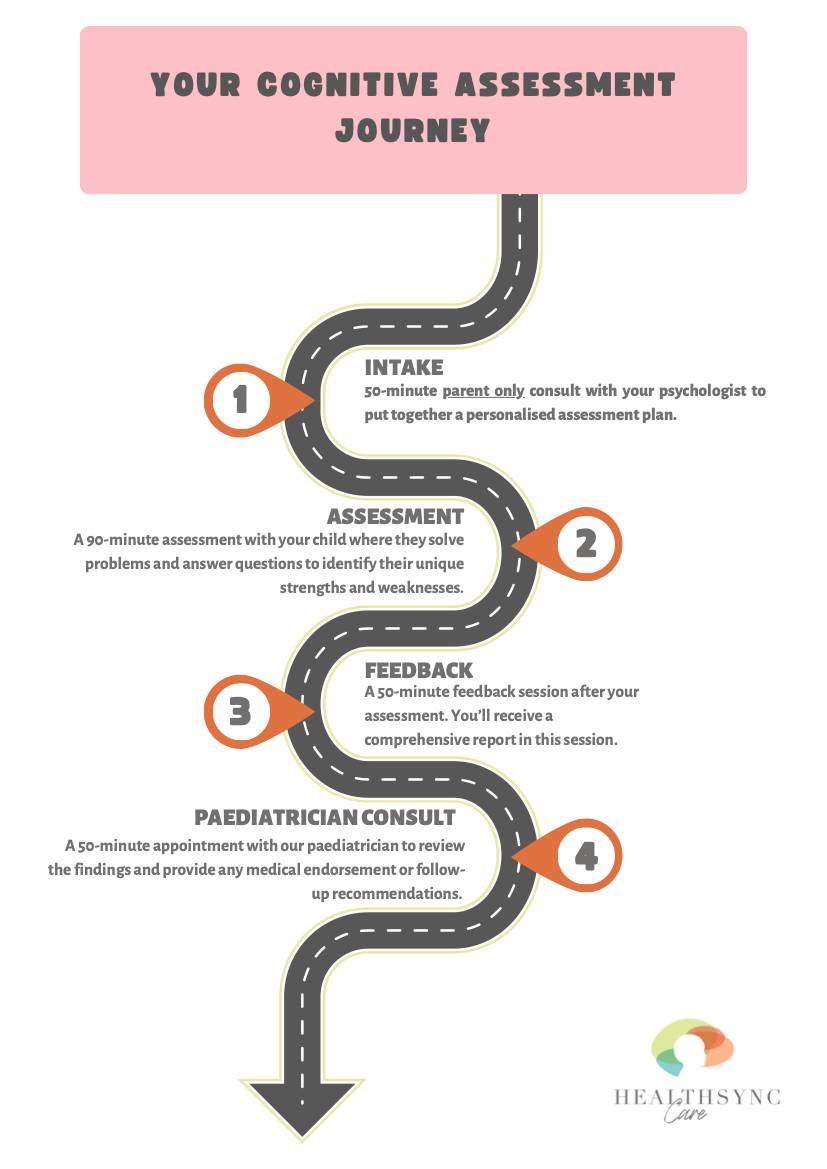
Our Cognitive Assessment Process
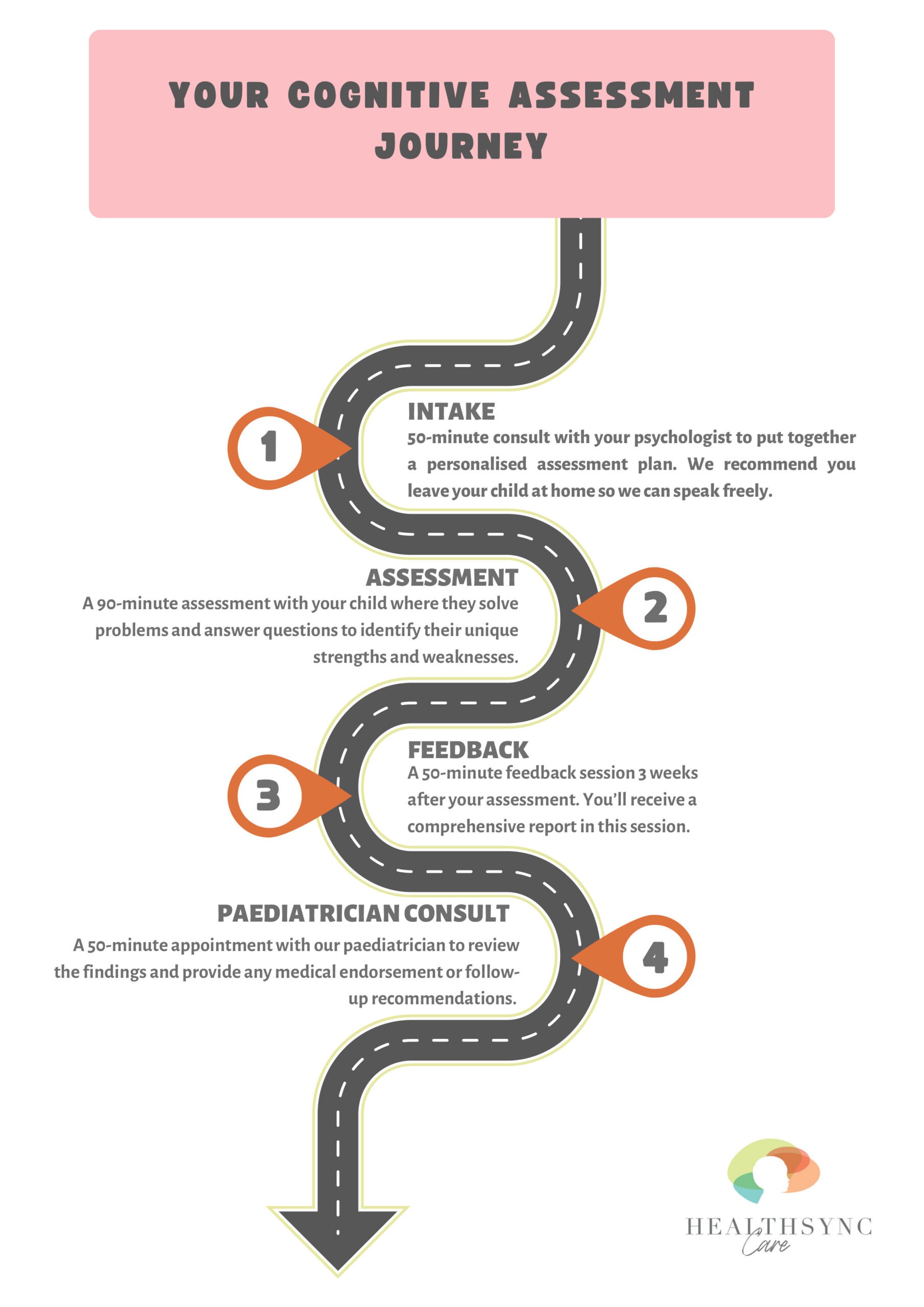
Intake
50-minute parent only consult with your psychologist to put together a personalised assessment plan.
Assessment
A 90-minute assessment with your child where they solve problems and answer questions to identify their unique strengths and weaknesses.
Feedback
A 50-minute feedback session after your assessment. You’ll receive a
comprehensive report in this session.
Paediatrician Consult
A 50-minute appointment with our paediatrician to review the findings and provide any medical endorsement or follow- up recommendations.
Meet Our Psychologists


COGINTIVE Assessments
Types of Cognitive Assessments Used
by HealthSync Care
At HealthSync Care, understanding exactly how your child thinks, learns, and processes information is at the heart of what we do. Our psychologists draw on a range of evidence-based cognitive assessment tools. Each tool has been chosen specifically for your child’s age and stage of development, helping our team uncover meaningful insights and deliver recommendations that drive real, lasting change.

Cognitive Ability
WISC
Wechsler Intelligence Scale for Children
A comprehensive assessment for school‑aged children ( 6–16 years) that evaluates core cognitive areas like verbal comprehension, reasoning, memory and processing speed to understand overall intellectual functioning.

Academic Achievement
WIAT
Wechsler Individual Achievement Test
A standardised measure of academic achievement that looks at skills in reading, writing, oral language and maths, showing how a child’s learning performance compares to expectations and identifying areas where they may need extra support. This measure is used for children and teenagers aged from 4 to 19 years old.

Early Cognitive Development
WPPSI
Wechsler Preschool & Primary Scale of Intelligence
A test for young children (about 2½ – 7 years) that measures early thinking and reasoning skills, helping build a picture of a child’s early cognitive strengths and needs.
Why choose HealthSync Care for Your Child’s
Cognitive Assessment in Sydney?
Our multidisciplinary team of allied health therapists, paediatricians and psychologists work with children and families to foster a supportive and collaborative environment. From psychological assessments (including ADHD, Autism Spectrum Disorder, and Cognitive Assessments for children from assessment through to ongoing therapeutic support, our clinicians help families navigate significant difficulties together.
Types of Specific Learning Disorder (SLD)
There are three main types of Specific Learning Disorders which might be identified through a cognitive assessment with HealthSync Care.

Dyslexia
Dyslexia is a common Specific Learning Disorder that affects reading, making word recognition and decoding difficult, which can hinder fluency and comprehension. Despite these challenges, dyslexia is unrelated to intelligence, and many individuals excel in areas like problem-solving or creative thinking.

Dyscalculia
Another form of Specific Learning Disorder is dyscalculia, which involves challenges with mathematical concepts and operations. Individuals with dyscalculia may find it difficult to understand mathematical symbols, memorise math facts, and solve mathematical problems.

Dysgraphia
Dysgraphia is another type of Specific Learning Disorder that impacts writing skills. Individuals with dysgraphia may face challenges with handwriting, spelling, and organising their thoughts on paper. Despite these difficulties, they often possess normal or above-average intelligence.
Get In Touch
We are here to support your child’s development and help your family navigate every step of the journey. Whether you have questions, need more information about our services, or want to schedule a consultation, we are always here to provide the guidance and care your child needs.
- Mon - Fri: 9am - 5pm
Directions to get to us
HealthSync Care is conveniently located to serve families across Sydney, with easy access by car or public transport.
Book now.
Call Us (02) 8378 5704Frequently Asked Questions
Why would a child have a cognitive assessment?
A child may have a cognitive assessment when there are suspected learning delays or exceeding learning abilities. Schools and parents can seek out these assessments to better understand how to support the child’s learning. These assessments can help clarify whether learning differences, difficulties with processing information, or patterns of thinking are influencing a child’s progress.
What are the most common types of Specific Learning Disorders (SLD)?
The most common Specific Learning Disorders relate to difficulties in specific academic areas. These include;
- Dyslexia, which affects reading and decoding skills;
- Dysgraphia, which influences written expression and handwriting;
- Dyscalculia, which impacts understanding numbers and mathematical processes.
These differences are distinct from overall intelligence and are identified through careful cognitive and educational assessment.
What are the 5 cognitive tests?
When psychologists refer to “five cognitive tests,” they often mean the core areas measured in a comprehensive assessment:
- Verbal comprehension (understanding and using language),
- Visual‑spatial skills (interpreting visual information),
- Fluid reasoning (solving new problems),
- Working memory (holding and using information),
- Processing speed (the pace of thinking and responding).
These domains compile the full-scale IQ and are typically captured in standard tools like the WISC.
What are common cognitive assessment tools for kids?
HealthSync Care utilises some of the most widely recognised cognitive assessments for children, including the Wechsler Intelligence Scale for Children (WISC), and the Wechsler Preschool and Primary Scale of Intelligence (WPPSI) for younger children, which covers general intelligence skills. HealthSync Care also uses academic tests, such as the Wechsler Individual Achievement Test (WIAT-3), as a standalone assessment or in combination with the above assessments.
Can a GP do a cognitive assessment?
In Australia, only qualified psychologists administer and interpret standard cognitive assessments, because these tests require specialist training and clinical judgement. A GP cannot conduct a full cognitive test but can help refer families to an accredited psychologist (like HealthSync Care) for assessment and support.
Who does cognitive assessments for children?
Cognitive assessments can be conducted by a range of qualified professionals, including clinical neuropsychologists and psychologists.
What are cognitive assessments and what do they measure?
Cognitive assessments are essential tools for evaluating how a child thinks, learns, and processes information. It is used to identify Specific Learning Disorders (SLD), a group of neurodevelopmental conditions that affect skills, such as memory, attention, language and processing speed. These tests can even find learning difficulties in children who are otherwise bright and have received appropriate teaching. They assess cognitive functioning and provide valuable insights into the child’s strengths and areas where they need support to enhance academic performance.

