
A Clearer Path Forward with Children's ADHD Assessments

Experienced, multidisciplinary team of clinicians

Client-centred care tailored to each child and their needs

Evidence-based interventions

Streamlined access to assessments for kids


Book a free 15 minute phone call to discover our options and find the right solution for you and your family.
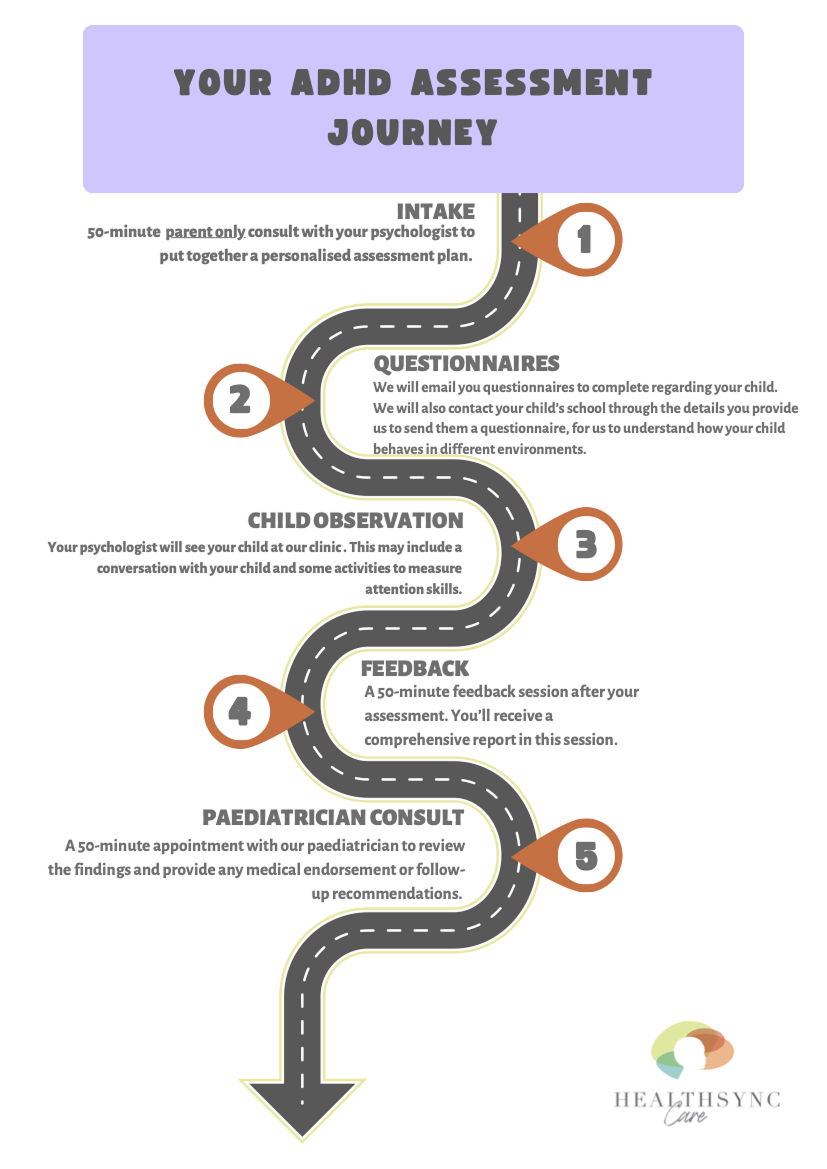
Our ADHD Assessment Process
HealthSync Care’s multidisciplinary team of psychologists and paediatricians work together to assess and support your child.
Our ADHD assessments help identify your child’s specific challenges, enabling appropriate treatment and care. We use the Conners Early Childhood assessment tool for young children between the ages of 2 and 6, and the Conners 4 for children and teenagers aged between 6 and 18 years old.
Intake
50-minute parent only consult with your psychologist to put together a personalised assessment plan.
Questionnaires
We will email you questionnaires to complete regarding your child. We will also contact your child’s school through the details you provide us to send them a questionnaire, for us to understand how your child behaves in different environments.
Child Observation
Your psychologist will see your child at our clinic. This may include a conversation with your child and some activities to measure attention skills.
Feedback
A 50-minute feedback session after your assessment. You’ll receive a comprehensive report in this session.
Paediatrician Consult
A 50-minute appointment with our paediatrician to review the findings and provide any medical endorsement or follow-up recommendations.
Meet Our Psychologists



adhd Assessments
How We Assess
ADHD in Early Childhood
Noticing something feels different about your child’s attention, behaviour, or development can bring up a lot of questions. Our early childhood assessments are purpose-built for little ones, giving us a clear picture of what’s happening and helping us provide your family with the right support at the right time.

Behavioural & Developmental Screening
Conners EC
Conners Early Childhood Assessment
Noticing something feels different about your child’s attention, behaviour, or development can bring up a lot of questions. Our early childhood assessments are purpose-built for little ones, giving us a clear picture of what’s happening and helping us provide your family with the right support at the right time.

Behavioural & Developmental Screening
Conners 4
Conners 4th Edition (Conners 4)
Conners 4 is a trusted ADHD assessment tool that gathers information about a child’s attention, behaviour and executive functioning from multiple sources— typically parents, teachers and in some cases the child themselves. It provides norm‑referenced rating scales that allow clinicians to compare a child’s behaviour to that of others in the same age group, helping to show how closely their patterns match symptoms associated with ADHD and common co‑occurring challenges like impulsivity and hyperactivity.
Why Choose HealthSync Care for Your Child’s ADHD Assessment in Sydney
Our multidisciplinary team of allied health therapists, paediatricians and psychologists work with children and families to foster a supportive and collaborative environment. From psychological assessments (including ADHD, Autism Spectrum Disorder, and Cognitive Assessments for children) from assessment through to ongoing therapeutic support, our clinicians help families navigate significant difficulties together.
Types of ADHD
ADHD is commonly categorised into three types, each presenting with its own unique characteristics, which can be identified through our ADHD assessment.

Predominantly Inattentive Presentation
Some children may find it hard to share play and attention with others, make eye contact consistently, respond to their name, use gestures like waving or pointing, or join in back‑and‑forth play.

Predominantly Hyperactive-Impulsive Presentation
This may present as frequent impulsivity, restlessness, fidgeting, interrupting others, or talking excessively.

Combined Presentation
This is recognisable through a combination of symptoms, including hyperactivity, inattention, and impulsivity.
Get In Touch
We are here to support your child’s development and help your family navigate every step of the journey. Whether you have questions, need more information about our services, or want to schedule a consultation, we are always here to provide the guidance and care your child needs.
- Mon - Fri: 9am - 5pm
Directions to get to us
HealthSync Care is conveniently located to serve families across Sydney, with easy access by car or public transport.
Book now.
Call Us (02) 8378 5704Frequently Asked Questions
Does private insurance cover ADHD assessments?
Yes, private health insurance can support children in accessing a high-quality ADHD assessment.
It can cover portions of the assessment cost; however, it will not cover the full fee, and the level of coverage varies by policy and the member’s level of coverage.
It is always recommended to check with your provider before undergoing an assessment.
How long does a children’s ADHD assessment take and what to expect?
At HealthSync Care, a children’s ADHD assessment typically takes 6-8 weeks to complete the five-step process :
- First, parents attend a 50-minute consultation with a psychologist to better understand their child’s difficulties and needs, and to create a personalised assessment plan.
- This is followed by questionnaires completed by parents and the child’s school teachers/educators to gather information about the child’s functioning and behaviour across different environments.
- The third session is a child observation session in which the psychologist will play games and activities with the child in the clinic.
- Once the assessment is complete, a 50-minute feedback session will be provided to discuss the findings of the comprehensive report and provide recommendations for on-going support.
- Finally, the process concludes with a 50-minute paediatrician consultation, during which the results are reviewed, and a medical endorsement or follow-up recommendations are provided.
What are 5 signs a child may have ADHD?
A child may have ADHD if you observe the following signs consistently across multiple settings (e.g, home and school) and it significantly impacts their daily functioning :
- Ongoing difficulty paying attention : Some children frequently struggle to focus on tasks and often fail to complete tasks. They become easily distracted, even during activities they enjoy and miss details.
- Frequent fidgeting or restlessness : Certain children can significantly struggle to sit still and are constantly moving or fidgeting.
- Persistent Impulsive behaviour : When a child finds it significantly challenging to wait their turn, regularly interrupts others before they have finished, or constantly acts on impulse without thinking.
- Constant difficulty following instructions : Constantly loses track of tasks, often appears distracted, or drifts into their own thoughts.
- Significant problems with organisation : Some children struggle when routines shift unexpectedly, often misplace things easily, or find it consistently difficult to complete or organise school work or other activities compared to others.
How do I get my children tested for ADHD?
There are various ways to get your child tested for ADHD.
Most people will begin by consulting their GP or paediatrician to rule out other possible causes.
If your practitioner believes your child has ADHD, they will often refer you to a psychiatrist, psychologist, speech-language pathologist, or occupational therapist, depending on your child’s primary needs.
The assessment for ADHD commonly involves parents, teachers, and a behavioural checklist to review symptoms across different environments.
Do I need a referral to get an ADHD assessment done?
At HealthSync Care, a referral is not required to proceed with an ADHD assessment.
But if you would like to claim some of the fees back on Medicare, you will need to provide us with a Mental Health Care Plan referral from your child’s GP.
For the paediatrician consult session in the assessment, you will also need to provide our team with a general GP referral.
Is an ADHD assessment covered by Medicare?
Yes, medicare covers some of the appointments included in our assessment processes, but not all. With the Better Access initiative, eligible clients can receive a Medicare rebate of up to $98.97 for the “Intake” session and up to $98.97 for the “Feedback” session.
A GP referral to our Paediatrician can also provide a rebate of up to $272.50 for the initial Paediatrician consult.

