Have you been wondering whether your child’s difficulties with focus, impulsivity, or restlessness might be connected to ADHD or require a cognitive assessment for children?
Attention Deficit Hyperactivity Disorder (ADHD) affects more than 280,000 children and adolescents aged 0-19 in Australia.
Australian clinical guidance also estimates that ADHD affects approximately 6-10% of children and adolescents, making it one of the most commonly recognised neurodevelopmental conditions in childhood.
For many families, getting a clearer picture of what may be happening can be an important step towards understanding how their child experiences the world and what supports may be helpful during key developmental stages.
We understand that the path to a children’s ADHD assessment in Australia can feel overwhelming, especially when you aren’t entirely sure where to start.
In this HealthSync Care guide we walk you through what the process for ADHD diagnosis looks like, who’s involved and what a thorough, evidence-based assessment covers.
This guide is intended to help you and your family understand what to expect when looking for ADHD assessment support from a psychologist and paediatrician in Bella Vista.
What is ADHD?
So, what is ADHD?
Attention Deficit Hyperactivity Disorder is a common neurodevelopmental condition that influences the way the brain manages attention, impulse control, and activity levels.
ADHD can affect the way a child manages attention, activity levels, impulses, emotions, and everyday routines.
Its impact can be seen across school, home, social activities, and a child’s view of themselves.
ADHD is diagnosed using recognised diagnostic criteria, such as the Diagnostic and Statistical Manual of Mental Disorders (DSM-5) or the International Classification of Diseases (ICD-11), together with clinical assessment.
During an assessment, the symptoms associated with ADHD must be present across more than one setting, such as both at home and at school.
These symptoms must meaningfully affect a child’s functioning or participation in everyday environments.
ADHD is a complex condition and can look different from one person to the next.
Some children may be visibly energetic and impulsive; others are quietly overwhelmed and internally dysregulated, which can sometimes be hard to notice for those around them.
For example, girls may be more likely to present with inattentive symptoms, which can be overlooked, while still creating real challenges in daily life.
The symptoms of ADHD can sometimes overlap with other conditions such as Autism, anxiety and learning differences.
A thorough assessment can be helpful, particularly where symptoms overlap with Autism, anxiety, learning differences, or other developmental or mental health concerns.
A multidisciplinary approach may support a more complete understanding of a child’s needs.
Finding a support plan that works for your family can help guide practical strategies at home, school, and in clinical care.
Common Symptoms of ADHD
As previously discussed, ADHD is complex and does not look the same in every child.
Symptoms can be influenced by age, personality, and sex, and they often manifest differently at home versus at school.
It’s also important to remember that many children with ADHD have strengths, creativity, enthusiasm, or the ability to focus deeply on subjects and tasks that genuinely engage them.
Inattentive Symptoms of ADHD
- Difficulties staying focused, especially with repetitive or unstimulating tasks.
- Losing track of instructions, belongings, or daily routines
- Finding it hard to know where to start with a task or schoolwork, even when they genuinely want to begin
- Finding busy or noisy environments hard to filter out
Hyperactive and Impulsive Symptoms
- A strong need to move; sitting still for long periods can feel very difficult
- Acting quickly or finding it difficult to pause before responding
- Being so full of ideas that it can be difficult to hold back or slow down
- Finding transitions or unexpected changes difficult, particularly where emotional regulation is also a challenge
For many families wondering if ADHD is present in their child, symptoms may become more evident once a child begins school, and children can have both inattentive and hyperactive-impulsive symptoms.
ADHD Presentations
ADHD is commonly described through three presentations, depending on the pattern of symptoms present.
- Combined Presentation: When a person experiences both inattentive and hyperactive-impulsive symptoms.
- Inattentive Presentation: When a person experiences difficulties with focus, sustained attention, organisation, or follow-through.
- Hyperactive-Impulsive Presentation: When a person experiences symptoms such as restlessness, fidgeting, impulsive actions, interrupting others, talking excessively, or difficulty waiting.
Why is Getting an ADHD Diagnosis Important?
For many families, pursuing a diagnosis can feel like a big step. But understanding what may be contributing to a child’s difficulties, rather than leaving it unnamed, can be an important step for many families.
A diagnosis can help a child and their family understand that their difficulties are not a personal failing and may provide a framework for support.
A diagnosis can also help parents, caregivers, and teachers consider environments and strategies that better support the child’s needs.
Without appropriate assessment and support, some children may spend years feeling like they’re not measuring up, whether at school, at home, or in social settings.
Despite constantly trying hard, these feelings of falling short can erode both a child’s confidence and sense of self over time.
A diagnosis may help families access more targeted support and planning for their child.
It can help inform educational planning, therapy options, practical strategies, and referrals to appropriate clinicians or support services.
At HealthSync Care, we see a diagnosis not as a label, but as a starting point.
One that can help families better understand their child’s needs, strengths, and support options.
Who Can Diagnose ADHD in Australia?
In Australia, ADHD may be diagnosed by appropriately qualified and trained health professionals, which may include paediatricians, psychiatrists, psychologists, and, in some settings, other medical practitioners with appropriate training and authority.
In many cases, more than one professional may be involved in the assessment or care process.
Paediatricians :
Paediatricians bring a medical perspective to an ADHD assessment.
Their medical training can help consider whether other medical, developmental, or mental health factors may be contributing to a child’s difficulties.
In many cases, a paediatrician may also discuss follow-up recommendations, including whether medication or other supports may be appropriate.
Psychologists :
Psychologists may conduct detailed clinical and behavioural assessments as part of the broader assessment process.
This may include gathering information from parents and caregivers, considering information from school where appropriate, observing the child, and using recognised tools that assess attention, behaviour, and areas of functioning.
The psychologist’s findings can contribute important information to the assessment report and recommendations.
Why a Multidisciplinary Approach Matters
Medical and psychological perspectives can complement each other, supporting a more rounded understanding of the child’s development, behaviour, health, and support needs.
At HealthSync Care, this multidisciplinary approach is at the heart of what we do.
Our ADHD assessments bring together psychology and paediatric input within a coordinated process, helping to build a comprehensive picture of a child’s needs.
ADHD Diagnosis Process
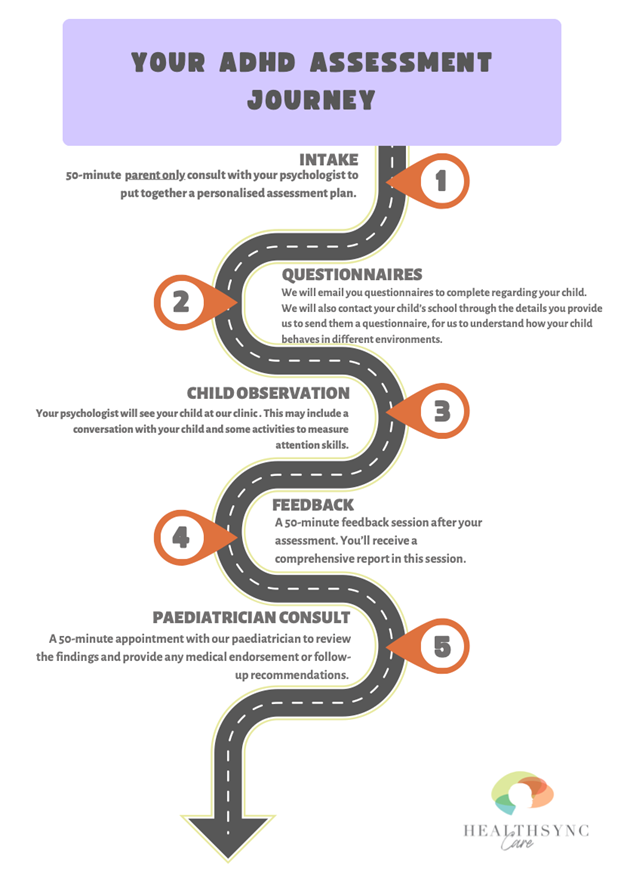
HealthSync Care’s psychologists and paediatricians work together to assess your child and provide recommendations for support.
Our child ADHD assessments in Bella Vista aim to identify your child’s strengths, challenges, and support needs, which can help inform appropriate recommendations.
As part of the assessment process, we may use recognised rating scales such as the Conners Early Childhood for young children aged 2 to 6, and the Conners 4 for children and teenagers aged 6 to 18, where clinically appropriate.
At HealthSync Care, our ADHD assessment follows a structured process that may include clinical interviews, parent and school information, rating scales, paediatric review, and tailored recommendations.
How Long Does it Take to Get an ADHD Diagnosis?
Wait times for an ADHD diagnosis in Australia can vary significantly depending on where you live, who you see, and how services are structured in your area.
In some parts of the country, families may experience long wait times before beginning the assessment process.
For families concerned about a child’s regulation, learning, or school engagement, waiting for support can feel difficult.
The length of the ADHD assessment process itself also depends on the provider.
Some clinicians in Australia spread appointments across multiple weeks, while others offer a more consolidated pathway.
What Affects Wait Times?
- Location: Metropolitan areas generally have more providers, though demand is also higher.
- Referral pathways: Some providers require a GP referral before an assessment can begin.
- How the assessment is structured: A fragmented process across multiple providers naturally takes longer than an integrated one.
- Co-occurring conditions: If Autism or a learning difference is also being explored, the assessment scope may be broader.
At HealthSync Care, our ADHD assessment process is designed to be coordinated, with psychology and paediatric input considered from the outset.
This may help reduce unnecessary duplication and support clearer communication between clinicians and families.
When to Consider an ADHD Assessment
There is no single situation or moment that signals it’s time to consider an ADHD assessment.
For most Australian families, the decision to seek advice builds gradually over time.
It could start from a comment from a teacher, a pattern you’ve noticed at home, or a growing sense that your child is finding certain things more difficult than they should.
If concerns are continuing over time, it may be helpful to seek advice from a GP, paediatrician, psychologist, or another appropriate health professional.
Signs it May Be Worth Exploring Further
It may be worth seeking professional advice if your child consistently experiences any of the following:
- Is regularly overwhelmed by tasks that feel manageable for other children their age
- Is finding it hard to keep up at school despite a genuine effort
- Experiences frequent emotional dysregulation that seems difficult to manage for their age or developmental stage
- Is disengaging from learning or activities they previously enjoyed
While none of these signs, on their own, confirm a diagnosis, they are still worth taking seriously.
Many families worry that their concerns aren’t significant enough to discuss with a professional, but you do not need to have all the answers before seeking advice.
A professional can help consider whether an ADHD assessment, another type of assessment, or practical supports may be appropriate.
Why Choose HealthSync Care?
At HealthSync Care, our clinicians work closely with families to provide evidence-informed ADHD assessments, tailored recommendations, and support options, including occupational therapy where clinically appropriate to help children develop everyday skills.
Whether you’re just starting to explore whether your child may have ADHD or you’re seeking further clinical input, our team can help you understand the assessment pathway and available support options.
When a child attends HealthSync Care, our aim is to provide a supportive and respectful environment for the child and family.
From ADHD assessments to Autism assessments, cognitive assessments, occupational therapy, psychology support and paediatric consultations, our clinicians provide personalised recommendations and care based on each child’s needs.
HealthSync Care also offers Autism assessments, cognitive assessments, occupational therapy, child psychology services, and paediatric consultations in Bella Vista, depending on each child’s needs.
Disclaimer:
This article provides general information only and is not a substitute for individual medical, developmental, psychological, or allied health advice. If you are concerned about your child’s development, behaviour, learning, or wellbeing, please speak with a GP, paediatrician, psychologist, or another appropriately qualified health professional.
Sources:
Deloitte Access Economics, The social and economic costs of ADHD in Australia: https://www.deloitte.com/au/en/services/economics/perspectives/social-economic-costs-adhd-Australia.html
Australian ADHD Professionals Association, Australian Evidence-Based Clinical Practice Guideline for ADHD: https://adhdguideline.aadpa.com.au/